
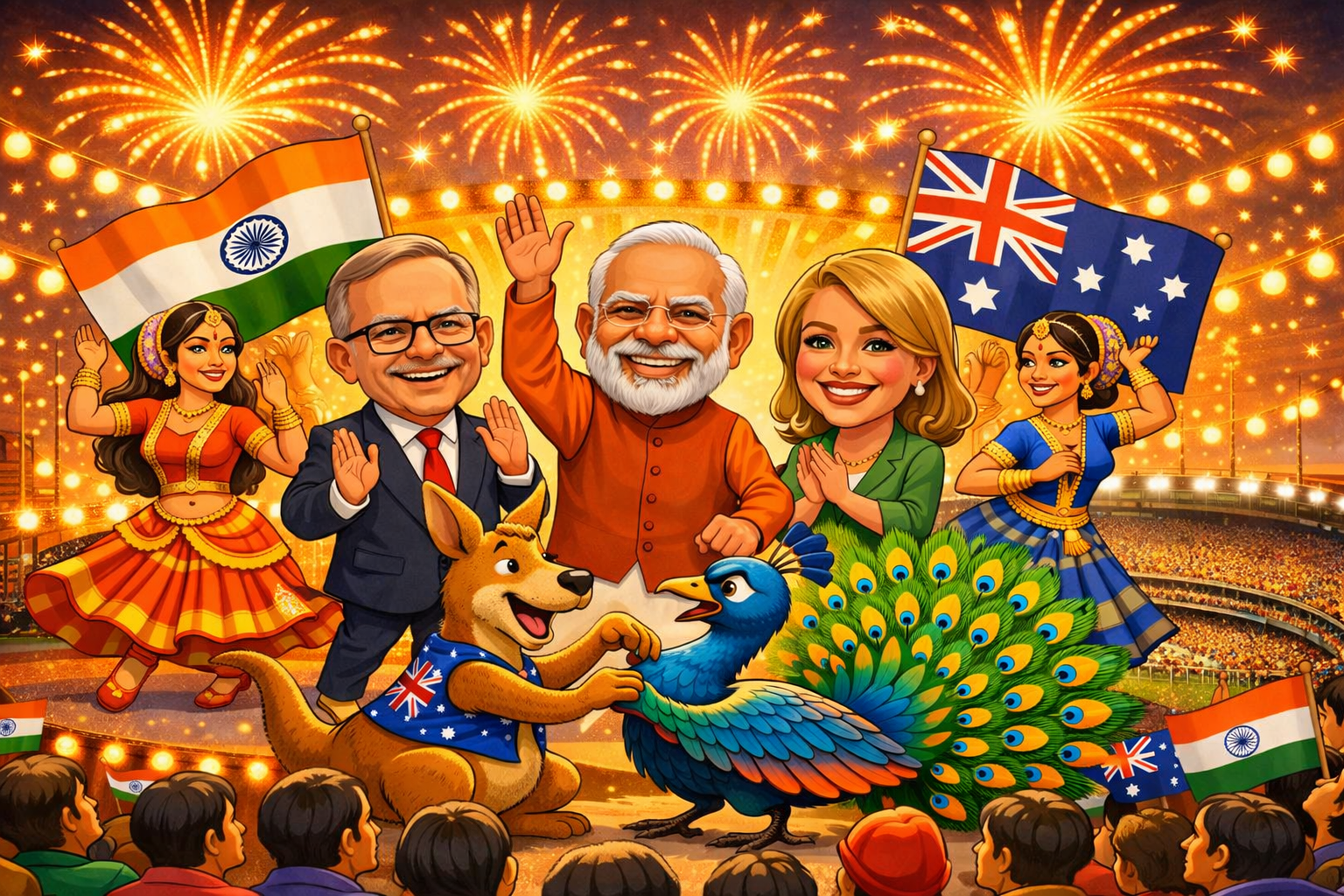
A vibrant illustration of India–Australia cultural diplomacy during Modi’s Melbourne visit.
Prime Minister Narendra Modi’s Melbourne event drew an estimated 40,000 attendees, a striking figure in a state with roughly 423,000 India‑born residents. That turnout represents 9–10% of Victoria’s Indian population and around 5% of Australia’s India‑born diaspora — far above the typical 2–3% participation seen in most diaspora community events.
The India‑born diaspora forms the core of Modi’s overseas audience: first‑generation migrants with lived ties to India’s political and cultural landscape. But the Indian‑Australian community is now broader than that. Australian‑born Indians — the second generation — are growing rapidly and often relate to India through culture rather than politics. Any reading of diaspora enthusiasm must distinguish between these two groups, whose motivations and identities are not identical.
Although framed as a celebration of India, the event was organised primarily by Hindu community groups with long-standing ties to Modi’s political base. The atmosphere was familiar: cultural performances, choreographed visuals, and a “rock star” stage presence that has become a hallmark of Modi’s overseas engagements. As with similar events in the US and UK, protests accompanied the spectacle, reflecting India’s increasingly polarised political climate.
Prime Minister Anthony Albanese and Victorian Premier Jacinta Allan attended the event in their capacity as hosts to a visiting head of government. Their presence served diplomatic, economic, and political purposes. With a federal election approaching, both leaders were keenly aware of the Indian community’s growing electoral significance, which has historically leaned toward the Labor Party. Many in the crowd were perhaps students or temporary residents — politically voiceless in Australia, yet symbolically powerful in the optics of diaspora diplomacy.
Beyond the spectacle, Modi’s visit was anchored in discussions around the Comprehensive Australia–India Cooperation Agreement (CACA), broader Australia–India trade initiatives, and the long‑standing issue of uranium exports. Australia approved uranium exports to India in 2014 under the Abbott government, but progress has been slow due to regulatory and procurement complexities. Modi’s visit provided an opportunity to reaffirm commitments and push forward stalled components of the trade relationship.
India’s emergence as a strategic partner in the evolving Israel–AUKUS–India alignment has opened new avenues for cooperation in critical minerals, defence technology, cyber security, education, and renewable energy. The Melbourne event, though community-driven, served as a stage for signalling these broader geopolitical shifts.
Modi also met Australia’s Leader of the Opposition, consistent with his diplomatic practice abroad. Interestingly, visiting dignitaries in India rarely meet India’s own LoP, highlighting a contrast between Modi’s international protocol and India’s domestic political norms.
Modi did not hold an open press conference during his visit — a long-standing feature of his media strategy. His public appearances were limited to speeches and joint statements, with no unscripted interactions with journalists.
Media reactions to the event were mixed. Supportive commentary emphasised India’s rising global profile and Australia’s strategic pivot toward the Indo‑Pacific. Critical voices questioned the scale and cost of the reception, asking whether taxpayer funds should support what was, in essence, a political rally for a foreign leader.
For politicians such as Pauline Hanson, large diaspora events often become evidence in arguments about migration levels and national identity, and Modi’s Melbourne rally fits neatly into this narrative.
Aside from Prime Minister Albanese and Victorian Premier Jacinta Allan, who welcomed Modi at the event, no major Australian politician issued a statement specifically about the Melbourne community rally. Opposition Leader Peter Dutton met Modi but did not comment on the event. The Greens raised broader concerns about human rights and taxpayer spending, while Pauline Hanson criticised the uranium export agreement reaffirmed during the visit
Australia’s broader political climate — marked by periodic spikes in anti‑migration sentiment — adds complexity. When diaspora events appear heavily influenced by the politics of the country of origin, they can strain India’s soft power rather than enhance it. Modi’s visits often prioritise domestic Indian audiences, with speeches crafted for broadcast back home, creating a disconnect between the spectacle and the local political context.
The Melbourne event was a successful community mobilisation, a diplomatic gesture, a trade signalling opportunity, and a political balancing act. It showcased the vibrancy of the Indian diaspora while highlighting the complexities of diaspora politics in an era where migration, identity, and geopolitics increasingly intersect.